


Clarity Through Clutter: ITS Workshop Advances Mid-Band Spectrum Access
Researchers from NTIA’s Institute for Telecommunications Sciences (ITS) designed a cross-disciplinary, collaborative workshop to explore ways to reliably expand access to mid-band spectrum.
Expanded access to mid-band spectrum is key to delivering faster wireless networks, fueling innovation, and securing America’s position as the world’s technological powerhouse. Accomplishing it begins with radio-wave propagation models produced with trusted measurements. NTIA’s spectrum laboratory, the Institute for Telecommunication Sciences, is leading technical collaboration across academia, industry, and government agencies to openly, accessibly, and comprehensively share all technical aspects of measurement and modeling activities to ensure secure and reliable spectrum use.
Access to mid-band spectrum is in high demand because it allows for higher bandwidth communications across practical distances using existing equipment. Under the One Big Beautiful Bill Act, NTIA must identify 500 megahertz in the band of frequencies between 1.3 gigahertz and 10.5 gigahertz for reallocation to full-power, commercial, licensed use cases. This mandate raises the importance of accurate propagation models for planning communication system deployments that allow new entrants to operate in this spectrum. Trusted measurements, combined with best practices in data analysis, are critical to developing and validating propagation models, especially models that account for the impact of foliage and the built environment (collectively called “clutter”).
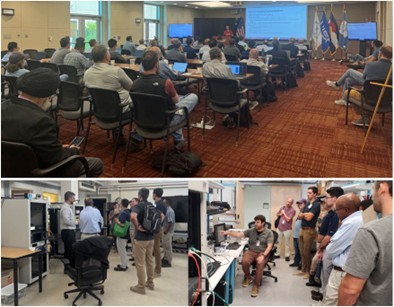
To support faster model development, ITS engineers Billy Kozma and Adam Hicks designed a three-day hands-on workshop that combined presentations, field measurement activities, and exploration of data analysis approaches. The workshop aimed to foster cross-disciplinary collaboration on methodologies, data, analytical tools, and findings that can be openly scrutinized, validated, and reproduced to advance mid-band spectrum solutions.
Over 50 participants from academia, industry, and government applied creative thinking and collaborative ideation in sessions on modeling approaches that leverage new datasets, data science tools, and physics-based constructions. Presentations and discussions exposed advanced techniques in propagation measurements and modeling that can lay the groundwork for greater access to interference-free spectrum.
A unique aspect of this workshop was a field measurement exercise where ITS deployed two transmitters, operating at 3.5 and 7.5 GHz, to provide a baseline environment. Attendees then used their own measurement systems to compare against ITS’s. Eight different organizations brought measurement systems to Boulder, six of which connected in parallel alongside ITS’s measurement system to allow for direct comparisons of clutter measurements in the same channel.
“The purpose was not to evaluate which system is ‘the best’ but to understand the capabilities and limitations of all systems such that they could support and contribute to the larger goal of improving clutter models,” said Kozma, who serves as the Propagation Modeling Program Lead. “A key goal of the workshop was to build community consensus on approaches to both developing and validating clutter models using measurement data.”
On January 13, ITS will host a follow-up virtual session for workshop attendees to continue engaging with spectrum stakeholders, present on their measurement findings, and support cross-comparison analyses.