



A Strong Signal During Every Phase: How ITS is Enabling Reliable Communications on the Moon
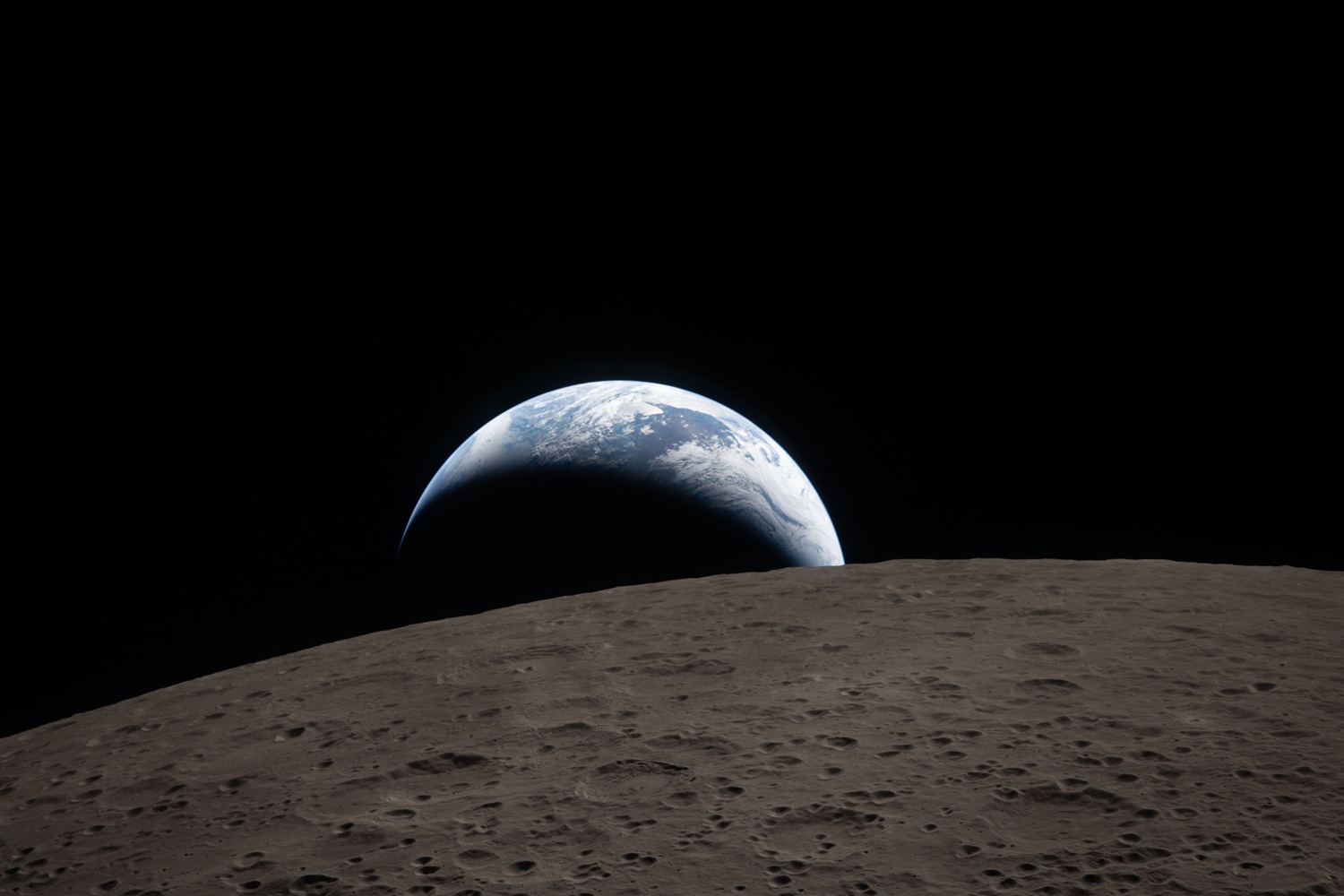
Almost 57 years after President Richard Nixon’s long-distance telephone call to the Apollo 11 astronauts—via radio—Artemis II marked mankind’s return to the lunar neighborhood. Following through on President Trump’s Executive Order on Ensuring American Space Superiority, NTIA’s Institute for Telecommunications Sciences (ITS) lab has helped to power Americans’ historic return, including by developing a model for understanding how communications signals travel on the Moon and between the Moon and spacecraft.
Our return to the Moon is a gateway for future space travel, economic development, and innovation—and U.S. leadership in spectrum innovation is critical to this effort.
Expanding our reach into space requires communications on and around the lunar surface, and that begins with understanding how wireless signals behave in these environments.
That requires new radio-wave propagation models, which predict how wireless signals behave as they move through space and around obstacles. Modeling propagation allows spectrum engineers to prevent interference and ensure communications signals reach their destination.
Engineers at ITS work with international bodies, such as the International Telecommunication Union (ITU), to reach agreement on how to model radio-wave propagation on the lunar surface.
That work has now produced a first-of-its-kind model for the lunar surface. In September 2025, a new P-Series Recommendation was published by the ITU Radio Communication Sector, Recommendation ITU-R P.2170, Methods and models for predicting lunar radio-wave propagation characteristics, and the Irregular Lunar Model (ILM) is now available via NTIA’s GitHub repository.
This recommendation builds on well-established theory and methodologies developed by ITS for the Irregular Terrain Model (ITM), originally designed to predict radio-wave propagation over the Earth’s surface. For lunar applications, the ITM was adapted to account for the Moon’s unique environment, including the absence of an atmosphere, increased surface roughness due to the lack of erosion, and the properties of the lunar regolith and its unique mineral composition—including elevated concentrations of titanium and iron.
"Although the lunar surface appears visually distinct from the Earth’s surface, it’s still governed by the fundamental laws of physics, allowing us to create a lunar model based on ITS’s Irregular Terrain Model," said ITS Director David Goldstein. "By enabling efficient spectrum management on the Moon, ITS’ model advances the Administration’s bold policy of leading the world in space exploration, security, and innovation."
"Modeling radio waves on the lunar surface forces us to re-think some of our default assumptions," said William Kozma Jr., head of ITS’s Propagation Modeling Research Program and the U.S. Delegation to ITU-R Study Group 3. "Atmospheric effects, such as atmospheric attenuation and ray bending, are phenomena we prioritize for terrestrial models due to the dynamic nature of Earth’s atmosphere. The presence of water vapor is absent on the lunar surface, resulting in simplified atmospheric modeling. Instead, diffraction and surface scattering effects will dominate, due to the unique mineral composition of the lunar surface."
The development of this model also serves an important strategic purpose for our Nation, as it will support the U.S. position for World Radiocommunication Conference 2027 (WRC-27) agenda item 1.15, which the U.S. team has led to a regional, Draft Inter-American Proposal. The proposal addresses the future of communications on the Moon’s surface and between spacecraft in lunar orbit and vehicles on the Moon.
With the Artemis program in full swing, ITS is proud to play a critical role in enabling robust, predictable lunar communications—ensuring that as we return to the Moon, our communications systems are as pioneering as the missions they support.