



Publications
Use the filters below to narrow publications by offices, programs or categories
Potential Interference From Broadband Over Power Line (BPL] Systems To Federal Government Radiocommunication Systems at 1.7 - 80 MHz Phase 2 Study
On October 14, 2004, the Federal Communications Commission (Commission or FCC) adopted a Report and Order that defined new Part 15 rules for Access Broadband over Power Line (BPL) systems. The National Telecommunications and Information Administration (NTIA) contributed to the Commission’s work by providing analysis to support recommendations for refinements in the rules and measurement guidelines in comments and staff correspondence filed in response to the Commission’s earlier BPL Notice of Proposed Rulemaking (NPRM). The NTIA Phase 2 study of Access BPL systems expands on its earlier Phase 1 study by providing additional modeling results and analyses to evaluate the effectiveness of the FCC’s rules and measurement guidelines in minimizing the potential for harmful interference to federal radiocommunication systems under worst-case conditions.
Assessment of Alternative Future Federal Land Mobile Radio Systems
This report evaluates the efficiency of federal spectrum use, performing a study that compares the spectrum resources used by several alternative land mobile radio (LMR) system architectures employing trunked radio technology to the spectrum resources used by the current conventional LMR systems. This study considered the 162-174 MHz federal LMR band in the Washington, D.C. area. The Washington, D.C. area was selected because it represents a spectrally congested environment and the 162-174 MHz band because it represents the most heavily used federal land mobile frequency band.
Description of a model to compute the aggregate interference from radio local area networks employing dynamic frequency selection to radars operating in the 5 GHZ frequency range.
This technical memorandum documents the analysis methodology that NTIA developed and used in assessing interference from radio local area networks to 5 GHz radar systems.
Correction Factors and Measurement Procedure to Assess the Interference Impact of Linear Swept Frequency Signals on Radio Receivers
This technical memorandum provides a methodology to determine the average and peak power level at the output of a filter with a linear swept frequency pulse train input to the filter. Using this method, peak and average power correction factors were developed that can be used compute the interference power level of a system that employs linear swept frequency signals.
NTIA letter to ICANN regarding cross-ownership issues for registries and registrars
NTIA letter to ICANN transmitting the U.S. Department of Justice Antitrust Division's advice on cross-ownership issues for registries and registrars for existing and new gTLDs.
A Nation Online: Entering the Broadband Age
A Nation Online: Entering the Broadband Age is the sixth report released by the U.S. Department of Commerce examining the use of computers, the Internet, and other information technology tools by the American people. Based on the U.S. Census Bureau’s Current Population Survey of 57,000 households containing 134,000 persons, this report provides broad-based and statistically reliable information on the ways that information technologies in general, and broadband more specifically, are transforming the way we live, work, and learn.
- The Census Bureau's Survey Instrument and Raw Data is available at https://www.census.gov
- PDF version of A Nation Online: Entering the Broadband Age
A Nation Online:
Entering the Broadband Age
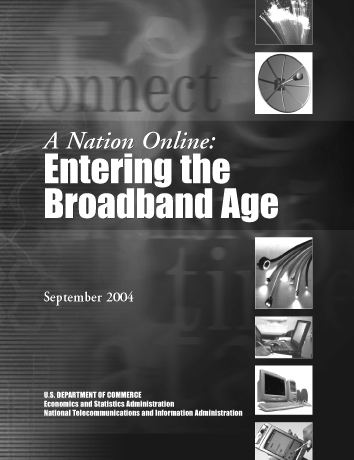
SEPTEMBER 2004
U.S. DEPARTMENT OF COMMERCE
Economics and Statistics Administration
National Telecommunications and Information Administration
NTIA Comments, issues related to the development and deployment of cognitive radio (CR) technology
U.S. Principles on the Internet's Domain Name and Addressing System
The United States Government intends to preserve the security and stability of the Internet's Domain Name and Addressing System (DNS). Given the Internet's importance to the world's economy, it is essential that the underlying DNS of the Internet remain stable and secure. As such, the United States is committed to taking no action that would have the potential to adversely impact the effective and efficient operation of the DNS and will therefore maintain its historic role in authorizing changes or modifications to the authoritative root zone file.
Networked Nation: Broadband in America 2007
Networked Nation: Broadband in America 2007 highlights the dramatic growth of broadband in the United States. The report shows that the Administration’s technology, regulatory and fiscal policies have stimulated innovation and competition, and encouraged investment in the U.S. broadband market contributing to significantly increased accessibility of broadband services.
THE GLOBAL INFORMATION INFRASTRUCTURE: AGENDA FOR COOPERATION
The purpose of this GII: Agenda for Cooperation is to identify the steps the United States, in concert with other nations, can take to make the vision of the GII a reality.

Image Credit
THE GLOBAL INFORMATION INFRASTRUCTURE: AGENDA FOR COOPERATION
Ronald H. Brown, Secretary of Commerce, Chair, Information Infrastructure Task Force
Larry Irving, Administrator National Telecommunications and Information Administration U.S. Department of Commerce Chair, IITF Telecommunications Policy Committee